Why Localised Bombing Data is Vital in UXO Risk Analysis

The legacy of WWII aerial bombing campaigns continue to pose a risk and present challenges for modern land development and construction. Despite over eighty years having passed since the last conventional aerial bomb was dropped over UK soil, this hazard remains in the form of undiscovered UXO (Unexploded Ordnance) and UXBs - Unexploded Bombs - which are routinely uncovered across the UK.
Historical bombing patterns and density, and the resulting UXBs left behind, are risk factors that can be mapped and understood through evidence-based research prior to any intrusive groundwork taking place in a given area, controlling risks and achieving an As Low As Reasonably Practicable (ALARP) residual risk level.
Here, we will discuss how careful analysis of bombing records negates miconceptions arising from relying solely on broad assumptions on WWII bombing patterns, and instead enables us to produce site-specific and reliable UXO risk assessments and UXO mitigation plans to effectively manage the risk of delays, costs and health and safety accidents to a project.
The ‘Blitz’
For the UK, the opening months of WWII are characterised by the Battle of Britain and the infamous ‘Blitz’ inflicted upon cities across the UK by the German Luftwaffe. Initially aimed at RAF airfields, the attacks soon came to concentrate on major cities and industrial centres, along with their civilian populations. Cities across the UK, such as London, Hull, Birmingham, Swansea, Belfast, Glasgow and others suffered terrible devastation – our ‘case studies’ page sheds describes many of these in detail.
A subsequent series of bombing raids occurred in 1942. Named ‘the Baedeker raids’, after the German Baedeker travel guides, these targets were chosen for their cultural and historical importance, as listed in Baedeker guidebooks— rather than purely military value. Viewed as retaliation for British bombing of German cities, they attempted to damage British morale by destroying cultural heritage. Exeter, Bath, Norwich, York, and Canterbury were the targeted cities during these raids.
The risk of encounter with associated wartime UXO in these areas is well known, anticipated and usually, well prepared for, with the norm being application of various UXO Risk Management services.
However, as recently exemplified by a UXB discovery in Newtownards, Northern Ireland, the risks of encountering wartime munitions in parts of the UK that were not as severely bombed must not be overlooked.
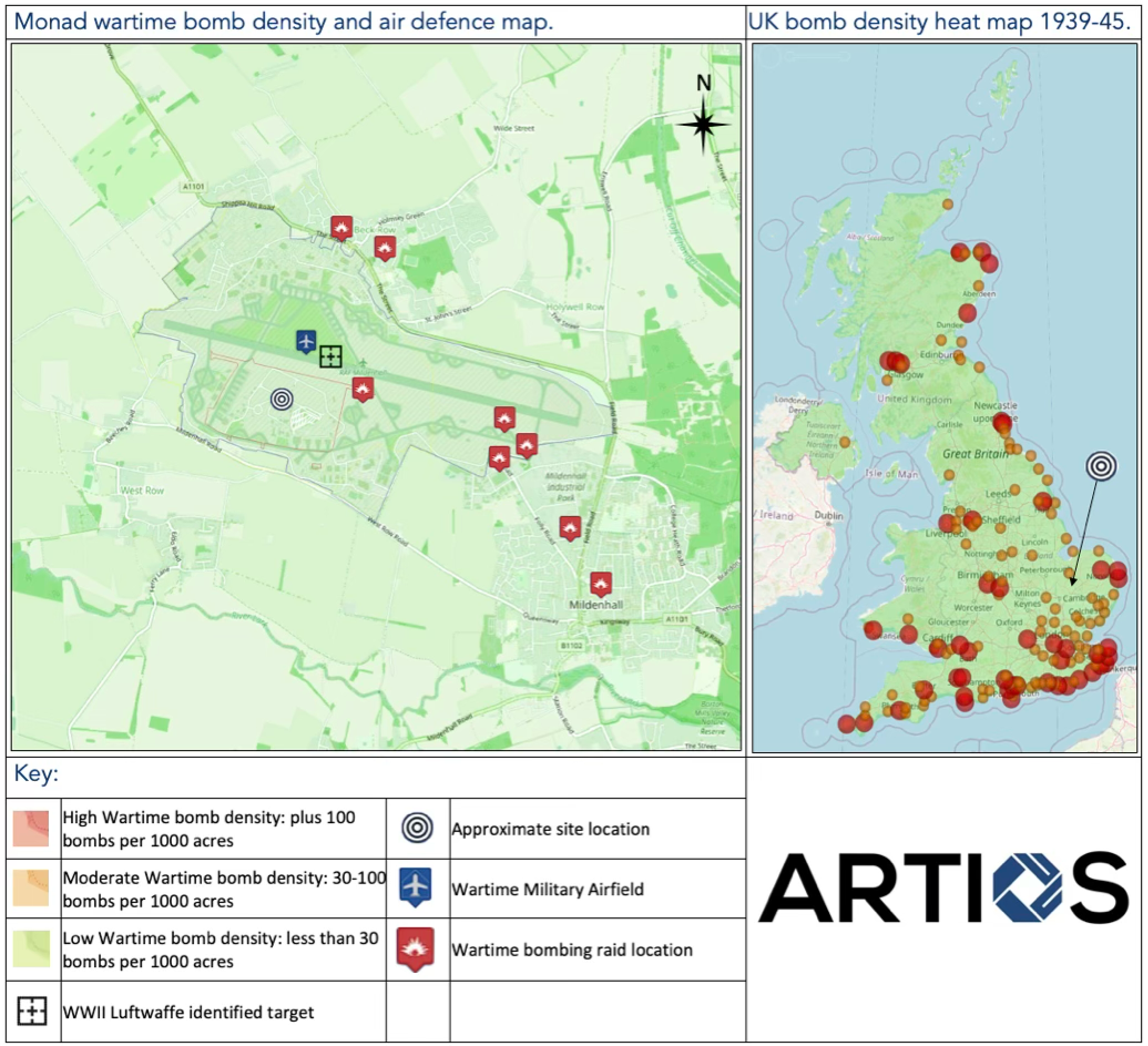
Map showing targeted bombing of RAF Mildenhall during WWII
Localised Bombing & Its importance
Wartime bombing density is typically classified into three distinct categories: Low, Moderate, and High, based on the numbers of bombs recorded to have been dropped within a specific area (e.g. 1000 acres) during WWII. While Moderate & High bombing densities are, naturally, recorded at major cities, transport/industrial hubs and ports, such as those mentioned above; even within areas that are classified as ‘Low’ bombing, targeted or ‘localised’ bombing of specific ‘high value’ installations such as key airfields or infrastructure may have led to UXO contamination during WWII.
Whilst these they may not present an obvious threat, this does not guarantee the absence of risk of encountering associated UXO. Ignoring this risk may result in site delays, cost overruns and safety incidents. This is why, to mitigate this risk, we take into consideration several other types of localised data, such as parish level records and wartime interviews/anecdotes, to reveal unexpected patterns.
Without this informed insight, sites can be affected by unplanned UXO discoveries mid-excavation, unexpected delays, as well as safety and compliance issues.
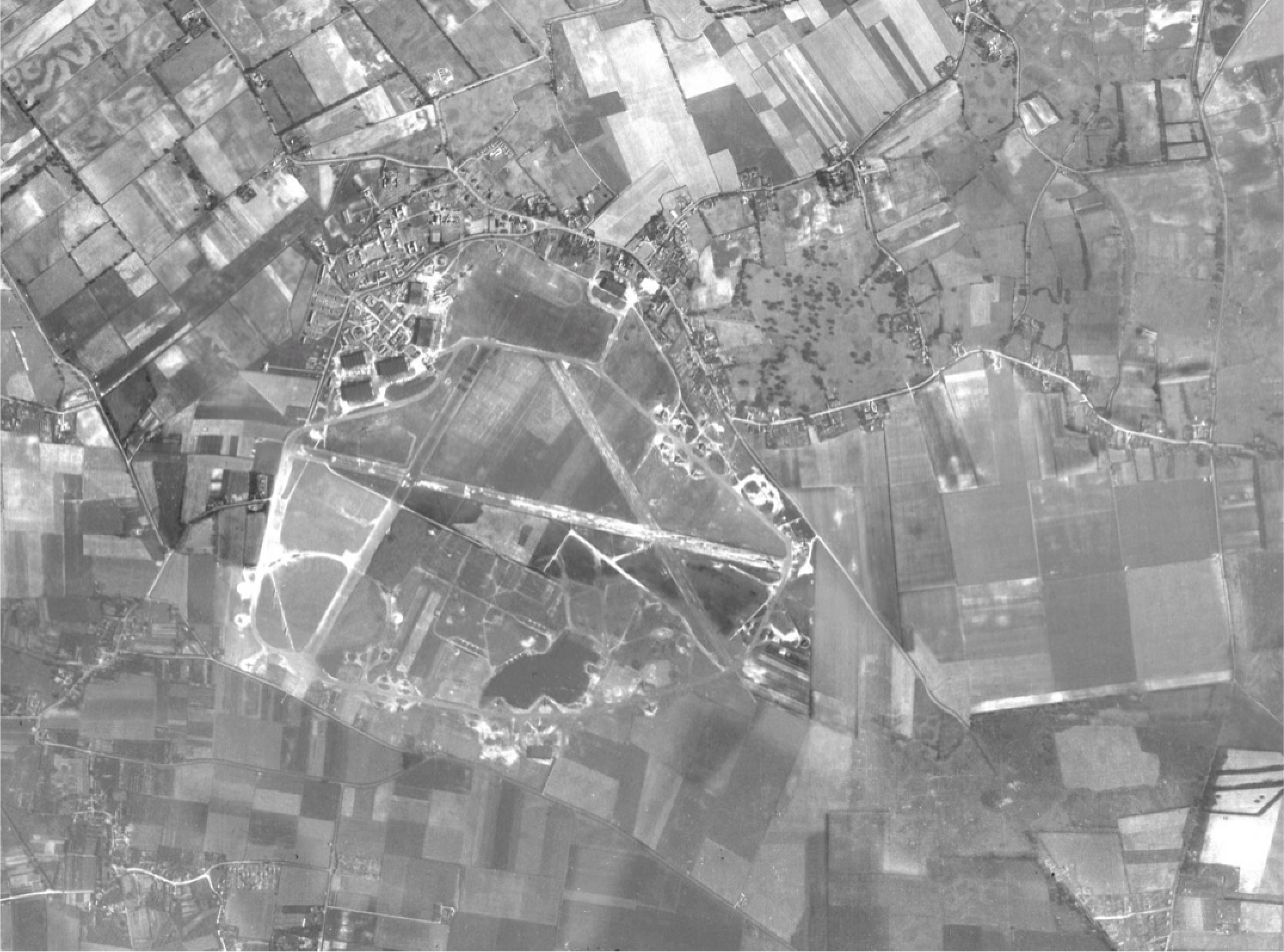
RAF Mildenhall c.1945
Case Study: RAF Mildenhall
An example of when site-specific bombing density was taken into consideration for UXO risk analysis was a Detailed UXO Risk Assessment for RAF Mildenhall in Suffolk, carried out on behalf of a UK Gov agency. On this occasion, research revealed that, despite a ‘Low’ density of wartime bombing recorded in the area, the local area around the RAF station may have sustained a higher concentration of bombing due to the specific targeting of RAF Mildenhall during the war. This was made more evident by records/anecdotes of several bombing raids targeting the airfield, which accounted for the majority of the bombing density reported for the overall region. In some cases, the exact areas of the airfield that were damaged in bombing raids were also mentioned.
Records unearthed by detailed research thus enabled Artios to revise the assessed level of UXO risk from WWII Aerial delivered bombs at the site and recommend suitable on-site mitigations, based on a better-informed assessment that took this factor into account.
By layering such historical insights into our analysis, we are able to move beyond broad assumptions and instead, efficiently produce site-specific assessments which are both reliable and actionable, enabling our clients to continue their work with minimised delays.
Gaining an understanding of localised bombing data, along with other wartime factors such as anti-aircraft defence patterns, assessed Luftwaffe strategies, and the extent and limitations of post-war land use and development gives context to the raw data, in turn informing more accurate risk mapping that is evidence-based, rather than just speculative.
Historical bombing patterns are not stand-alone relics of the UK’s history - instead they are measurable factors in UXO threat today which we can utilise to reduce risks and hazards. Our tried-and-tested approach, together with insight into localised data, provides our clients with confidence in their risk management strategies.