Post WWII Explosive Ordnance Clearance in the UK: An Enduring Legacy
After WWII, thousands of items of unexploded ordnance remained buried beneath cities, coastlines, farmland, docks, and industrial infrastructure across the UK. While much public attention focused on German bombing during the Blitz, a substantial challenge also existed in areas where Britain had established dense wartime defences, as well as across areas where military training has been conducted.
In this article, we explore national efforts undertaken to clear the UK of this explosive ordnance contamination and the hazards that still persist today.
The Scale of the Post-War Threat

WWII Defences (Pillbox) still found across the coast
During the Blitz and subsequent Luftwaffe campaigns, German aircraft dropped millions of bombs on Britain, a percentage of which failed to detonate on impact. Royal Engineers records suggest that by February 1946, over 45,000 unexploded bombs had been dealt with across Great Britain. However, the problem extended far beyond aerial bombs.
Britain’s wartime defensive preparations created approximately 2,000 coastal minefields containing around 350,000 mines, particularly concentrated in East Anglia and southern coastal regions. These minefields were laid across beaches and dunes to deter a potential German landing during WWII. Between June 1940 to June 1942, an extensive programme of work was undertaken to develop defences around the UK, including blocking egress from beaches, anti-tank and personnel obstacles, and wiring. Extensive minefields were laid between these obstacles. After victory in Europe, these same defences became a danger to civilians, fishermen, and returning coastal communities.
The UK’s wartime mobilisation had also transformed rural landscapes into intensive military training grounds. Areas such as the Stanford Battle Area in Norfolk, Otterburn in Northumberland, Salisbury Plain, Penhale Sands in Cornwall, and ranges across Scotland and Wales, were used continuously by British, Commonwealth, and Allied troops. In addition to millions of munitions discharged here during live firing practices, large quantities of ammunition were abandoned at former military camps, airfields, ports, and training grounds.
Recent incidents ( https://www.bbc.co.uk/news/articles/clyry40jgq5o) include UXO discoveries in Crimdon Dene in April 2026, where over 150 self-igniting phosphorus grenades dating back to WWII were uncovered, prompting controlled detonations by the Army’s explosive ordnance disposal team after one individual sustained minor burns. Such incidents demonstrate that the post-war clearance mission remains unfinished more than eighty years after the conflict.
Clearance activity
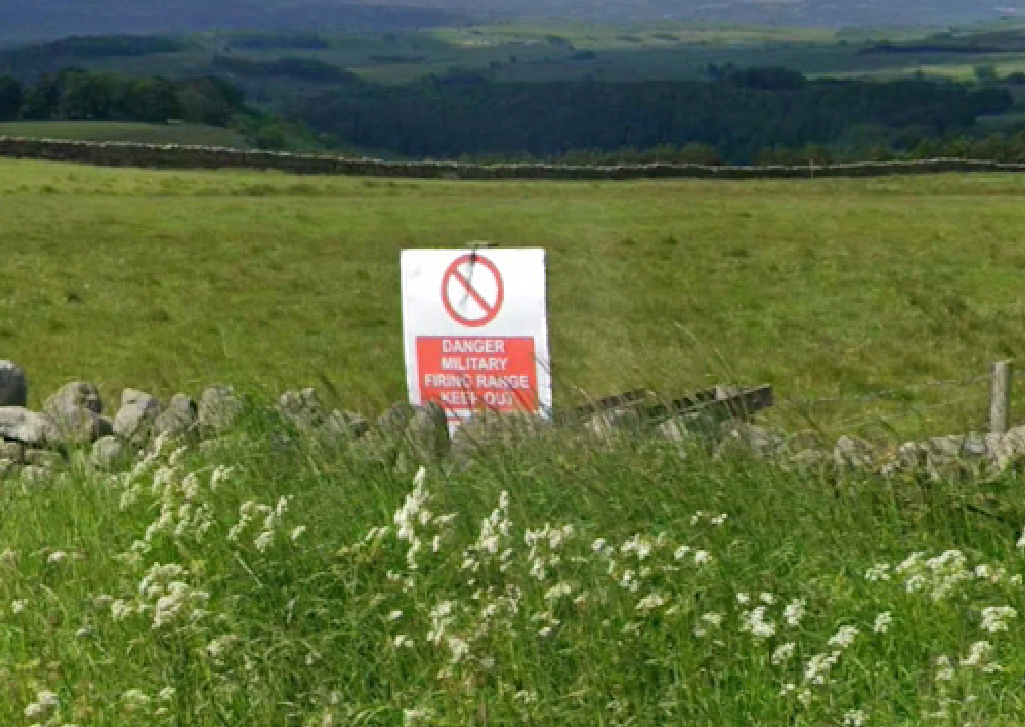
Military Firing Ranges - Restricted public access
By 1943, the threat of invasion had receded and work began on the clearance of coastal minefields, initially undertaken by Royal Engineer units of the British Army. Wartime minefields were often poorly mapped, coastal erosion had shifted buried mines, and many devices had become unstable after prolonged exposure to saltwater and weathering. Clearance teams suffered casualties throughout the operation, underscoring the persistent danger posed by wartime explosives, even during peacetime. The last beach to be cleared was at Trimingham, Norfolk, with access barriers finally removed in August 1966.
Post WWII, clearance operations also began in military training areas and across land requisitioned for wartime military use. A prominent example was at Salisbury Plain (now Salisbury Plain Training Area - SPTA), one of Europe’s largest military training estates, which became a continuous focus of ordnance clearance after 1945. During WWII, the plain hosted artillery training, anti-aircraft practice, demolition instruction, and preparations for the Normandy invasion. The intensity of wartime activity left extensive UXO hazards across impact areas and manoeuvre zones. Royal Engineers clearance teams operated continuously on the Plain during the late 1940s and 1950s, enabling roads, rail crossings, and selected agricultural land to reopen safely. However, much of Salisbury Plain remains permanently designated as military land because comprehensive clearance proved impractical. Clearance responsibilities later became integrated into broader Defence Training Estate management procedures. Modern explosive ordnance clearance on training areas now combines military EOD teams, specialist civilian companies, and environmental management frameworks.
Similarly, the Stanford Battle Area in Norfolk (STANTA), created in 1942 to prepare Allied forces for operations in Europe, covered roughly 30,000 acres and included mock villages, anti-tank ranges, artillery zones, and urban warfare facilities. The area experienced intensive live-fire use throughout the war and remained contaminated afterward. Royal Engineers clearance teams conducted systematic clearance of the area after the war, particularly in zones intended for civilian access or agricultural use. As with SPTA, complete clearance of the area proved unfeasible and significant areas remained under military control indefinitely. Indeed, the persistence of UXO contamination became one reason why many evacuated villages within STANTA were never reoccupied. Periodic clearance operations continue today whenever construction, training or other land use activities necessitate.

Imber Firing Ranges - 1945
Kingley Vale in West Sussex provides another notable example of the long-term legacy of wartime military training areas and the subsequent need for post-war explosive ordnance clearance. During WWII the secluded valley and surrounding downs were used extensively by British and Canadian forces for infantry training, including exercises with Bren guns, 2-inch mortars, rifle ranges, demolition charges, and Home Guard Auxiliary Unit preparations. Following the war, Royal Engineers, and later, specialist commercial UXO risk management companies undertook periodic survey and clearance operations to reduce the risks posed by wartime UXO contamination. Modern investigations and clearance work at Kingley Vale have included UXO survey and clearance operations. This risk highlights the ‘lesser known’ wartime training areas, as they are usually open to the public and not under military control, increasing the likelihood of chance encounters.
UXO Risk Mitigation

The frequent discovery of wartime explosive ordnance in these military training areas serves as a reminder of the enduring legacy of the World War II. Despite Britain’s large-scale peacetime survey and clearance efforts, complete clearance of historic training areas remains elusive. The integration of Explosive Ordnance Clearance responsibilities into broader Defence Training Estate management procedures highlights the importance of balancing military necessity with public safety. Public footpaths and access near danger areas require continuous monitoring, warning systems, and periodic explosive ordnance clearance operations.
Environmental considerations are especially important as large undeveloped moorland and heathland areas are key sites for ecological conservation. For example, Salisbury Plain holds the largest remaining area of species-rich calcareous grassland in northwest Europe. As such, many areas hold multiple protections, including Special Area of Conservation (SAC), Special Protection Area (SPA), and Site of Special Scientific Interest (SSSI).
While established many modern military training areas pose a greater UXO risk in terms of scale, the risks are relatively well known and UXO survey and clearance tasks now form part of routine procedure. Greater concern often exists at locations such as Kingley Vale, where there is less awareness of wartime military training or live firing having been conducted. Here, thorough holistic research and careful analysis are essential to accurately identify and assess UXO risks that may still be present.
Artios’ proven desktop survey methodology combines archival research, mapping analysis through the use of bespoke GIS tools, and where appropriate intrusive and non-intrusive surveys to provide our clients with a proportionate understanding of potential explosive ordnance hazards. Through this, we are able to support safe on-site survey and clearance activities to enable development and land use across explosive ordnance affected areas across the UK.